Ask ten DJs to explain the difference between house and electro and you will get twelve answers. The genres share enough genetic material that the boundaries have always been porous, and any attempt at clean taxonomy runs into immediate exceptions. But the distinction is real. It shows up in the way records feel on a dancefloor, in the way DJs program their sets, and in the way labels define their catalogs. Understanding where house and electro diverge, and more importantly, where they converge, is one of the more useful things you can do if you care about how electronic music actually works.
Defining House

House music begins in Chicago in the early 1980s. The foundational story is well known: Frankie Knuckles at the Warehouse, Ron Hardy at the Music Box, the first generation of producers working with drum machines and synthesizers in home studios on the South Side. What emerged was a form built on the 4/4 kick drum, a steady rhythmic pulse that prioritized continuity over disruption. Early tracks like Jesse Saunders' "On and On" (1984), Farley "Jackmaster" Funk's "Love Can't Turn Around" (1986), and Marshall Jefferson's "Move Your Body" (1986) established the template: a driving kick, syncopated hi-hats, warm basslines, and vocals that ranged from soulful to ecstatic.
The tempo range for house sits broadly between 118 and 128 BPM, though this is a guideline rather than a rule. Deep house tends toward the slower end, while peak-time club tracks push higher. The defining quality is warmth. Even at its most stripped-down and mechanical, house retains a human center. The influence of disco, gospel, and soul is always audible, whether in an explicit vocal sample or just in the way the bassline moves.
Over four decades, house has fractured into dozens of subgenres: deep house, acid house, tech house, Afro house, lo-fi house, progressive house, minimal house. What unites them is the 4/4 framework and a feeling of propulsion. House builds, layers, and accumulates energy. The best house tracks feel like they are carrying you somewhere, even if you are standing still.
Defining Electro
Electro's origin story overlaps with house but points in a different direction. The genre crystallized in the early 1980s around the Roland TR-808 drum machine, with Afrika Bambaataa and the Soulsonic Force's "Planet Rock" (1982) as the commonly cited starting gun. But where house drew from disco and soul, electro drew from Kraftwerk, science fiction, and the mechanical pulse of the machine itself. The foundational electro records, Hashim's "Al-Naafiysh (The Soul)" (1983), Egyptian Lover's "Egypt, Egypt" (1984), and Cybotron's "Clear" (1983), are colder, harder, and more angular than their house contemporaries.
Electro runs at 125 to 135 BPM as a rough bracket, though it often feels faster than house even at similar tempos because of the rhythmic emphasis. Where house sits on the kick drum, electro sits on the snare and the clap. The 808 cowbell and open hi-hat are signature sounds. The groove is syncopated and robotic, with a swagger that comes from the machine rather than from the human playing it. Basslines tend to be synthetic and buzzing rather than warm and round.

The Detroit connection is critical. Drexciya, the mysterious duo of James Stinson and Gerald Donald, took electro into underwater mythology and Afrofuturism across a discography that ran from 1992 to 2002. Their records on Tresor, Underground Resistance's Submerge label, and their own Hydro Doorways imprint defined a strain of electro that was simultaneously funky and alien, deeply physical and utterly strange. In Europe, labels like Bunker Records in The Hague and Viewlexx in the Netherlands built a parallel tradition of raw, unpolished electro that emphasized distortion and rough edges.
More recently, artists like Helena Hauff, DJ Stingray, Alienata, and Umwelt have carried electro into the 2020s. Hauff's Return to Disorder label and her Boiler Room sets demonstrate that electro remains vital and evolving. It has never had the mainstream reach of house, which is partly why it retains an outsider energy that house sometimes struggles to maintain.
Where the Lines Blur
Here is where it gets interesting. The genres share enough DNA that the boundary between them is often a matter of emphasis rather than hard distinction. Consider a track like Interplanetary Criminal's "Bruk It" or any number of records on the funkier end of the Clone label's catalog. Clone, operating out of Rotterdam since 1993, stocks both house and electro and has always treated them as adjacent rather than separate. Their sub-labels tell the story: Clone Aqualung Series for deep electro and techno, Clone Jack For Daze for house and disco, Clone Basement Series for raw hardware jams that could go either way.
DJ Stingray is perhaps the best example of an artist who refuses the binary. His sets move fluidly between electro, house, techno, jungle, and juke, often at tempos that split the difference. A Stingray mix might sit at 130 BPM and feature tracks that are technically house in their structure but electro in their sonics, with 808 percussion, acid basslines, and a mechanical intensity that owes more to Detroit than to Chicago. Is he playing house or electro? The question is less useful than just listening.
Labels like CPU Records in Sheffield, Frustrated Funk in Rotterdam, and Crème Organization in The Hague operate in this border zone permanently. They release records that pull from both traditions without anxiety about categorization. CPU's roster includes artists like Sync 24, Cygnus, and Plant43, whose music sits exactly at the intersection of warm melodic house pads and cold electro drum programming. The result is something that does not need a genre tag to make sense on a dancefloor.
Why the Distinction Matters for Curation
If the boundary is so porous, why bother maintaining it at all? Because genre distinctions, even imperfect ones, are tools for communication. When we program an electro session differently from a house session on Unchained Radio, we are not claiming they are hermetically sealed categories. We are giving listeners a way to orient themselves. If you want to hear 808-driven machine funk with a colder edge, the electro session gets you there. If you want four-on-the-floor warmth with a soulful undertone, the house session is the starting point.
This is the same logic that drives record shops. When Juno Records files a release under "electro" rather than "house," they are making a curatorial judgment about feel, not enforcing a scientific classification. The terminology we use shapes how we listen. Calling something "electro house" versus "house with electro influences" versus just "electro" sets different expectations, and those expectations affect what a listener pays attention to. Genre labels are imperfect, but they are not meaningless.
Where Interesting Things Happen
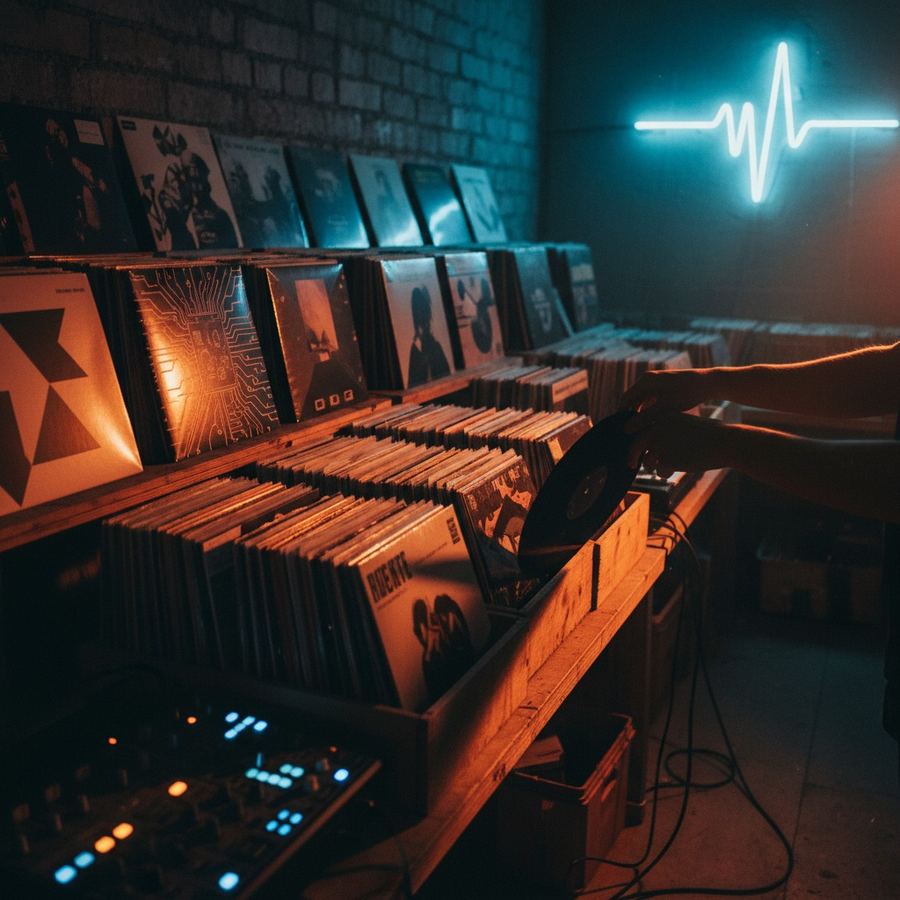
The most compelling music often comes from artists who understand both traditions deeply enough to pull from each without settling into either. Mor Elian's programming moves between tough electro, deep house, and broken beat with a fluidity that comes from genuine knowledge of all three. Objekt builds sets fundamentally about the collision between genres, using the tension between different rhythmic frameworks as a source of energy.
For underground electronic music, the intersection of house and electro is one of the most productive creative spaces. It is where Machine Woman's raw hardware tracks live, where Pangaea's restless genre-hopping leads, and where the entire Dutch school of electro-house hybrids from the early 2000s came from.
The lesson for listeners is simple: learn the difference, then stop worrying about it. Understanding that house and electro have distinct histories, distinct sonic palettes, and distinct rhythmic logics makes you a better listener. It gives you vocabulary and reference points. But the dancefloor does not care about taxonomy. What matters there is whether the record hits, whether the energy is right, whether the DJ has read the room. And the DJs who read rooms best are the ones who can reach into both crates without hesitation, pulling the house record that has electro's edge or the electro record that has house's warmth, and dropping it at exactly the right moment.