The history of internet radio for dance music is not a story about technology. It is a story about people who needed a broadcast medium that did not exist yet, so they built one. Every significant development, from the first SHOUTcast streams in the late 1990s to the studio-quality operations running today, was driven by the same frustration: commercial radio would not play this music, and the people who loved it needed somewhere to hear it and share it.
That frustration turned out to be one of the most productive forces in electronic music. It built an infrastructure that now operates globally, serves millions of listeners, and has launched careers that commercial radio never would have touched. Here is how it happened.
The SHOUTcast and Icecast Era: Late 1990s to Early 2000s
Internet radio became technically possible in the mid-1990s, when audio compression and broadband connections converged. But it became culturally important for dance music around 1999, when two pieces of free software, SHOUTcast and Icecast, put broadcast capability in the hands of anyone with a computer and an internet connection.
SHOUTcast, developed by Nullsoft (the company behind Winamp), turned a home PC into a streaming server. Icecast, its open-source counterpart, did the same thing with fewer restrictions. Neither required a license, a studio, or permission from anyone. You installed the software, configured your stream, listed it in a directory, and you were broadcasting. The barrier to entry dropped from thousands of dollars in FM equipment and an FCC license to essentially zero.
For dance music, this was transformative. By 2000, hundreds of small stations were streaming house, techno, trance, drum and bass, and every subgenre in between. Most had audiences measured in dozens. The audio quality was rough, limited by bandwidth. Streams ran at 56kbps or 128kbps, and buffering was constant. But for listeners in cities without record shops or club scenes, these streams were the only access point to underground electronic music.
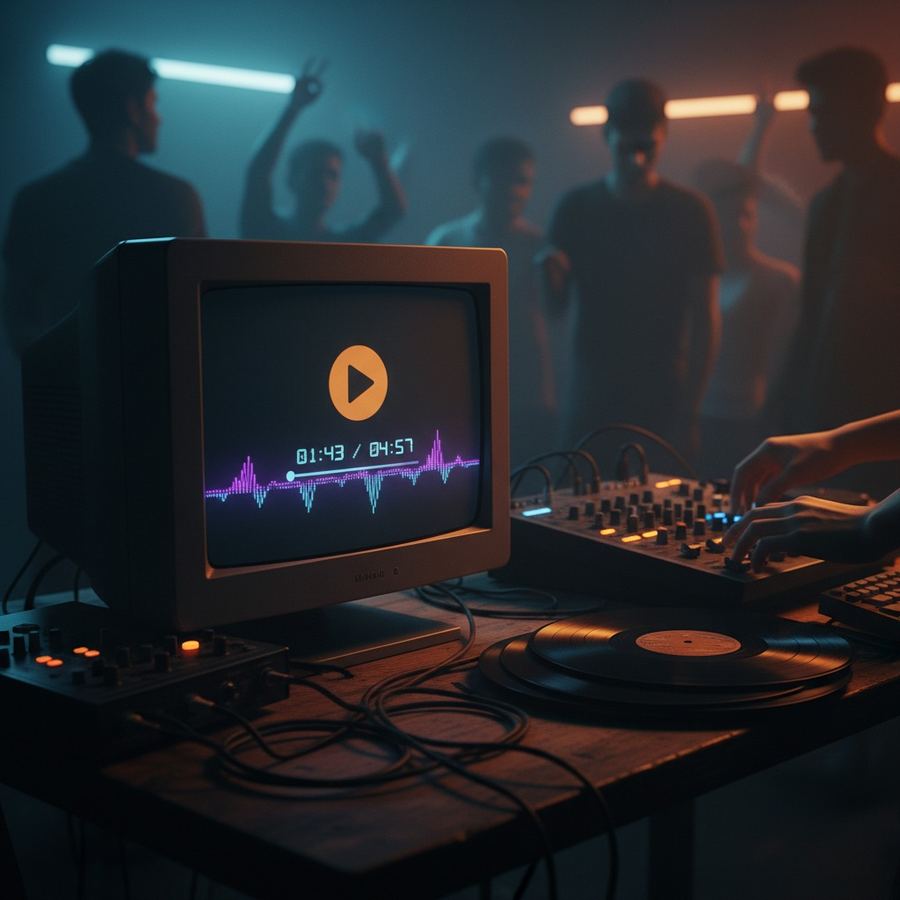
The streams used .pls and .m3u playlist files, simple text documents containing the URL of the audio stream. You clicked a link, Winamp opened, and the music started. No profiles, no followers, no likes. Just audio.
The Wild West of Directories
With hundreds of stations appearing monthly, directories became essential. SHOUTcast maintained its own directory organized by genre. Live365 offered a more polished interface for users who did not want to run their own servers. Browsing them was an act of exploration that has no equivalent today.
Clicking through the electronic music category on the SHOUTcast directory in 2002 was genuinely unpredictable. You might land on a DJ in Osaka streaming minimal techno from a bedroom, a crew in Manchester running a pirate station that also streamed online, or a college student in Michigan playing their record collection for an audience of eight. Curation happened at the listener level: you found the streams that matched your taste and bookmarked them.
The First Dedicated Electronic Music Stations
As the technology matured, more ambitious projects emerged. Digitally Imported (DI.fm), launched in 1999, became one of the first internet radio stations to build a significant audience specifically for electronic music. It operated multiple genre-specific channels and maintained a level of consistency and audio quality that set it apart from bedroom operations. Proton Radio, focused on progressive house and melodic electronic music, built a dedicated following through carefully curated programming.
These stations were closer to format radio translated to the internet: genre channels with reliable programming but limited editorial personality. What they proved was that an audience existed. People would listen to electronic music radio if it was available. That proof of concept mattered for everything that followed.
Simultaneously, pirate stations began adding online streams to FM broadcasts. Rinse FM in London, pirate since 1994, started streaming online and reached a global audience. The music Rinse championed, UK garage, grime, dubstep, found listeners far beyond its illegal transmitter. Our piece on community radio covers this crossover between terrestrial and online broadcasting.
The Podcast Interlude
The mid-2000s brought podcasting, and for a period the DJ mix podcast threatened to replace internet radio. The logic was compelling: why listen live when you can download a mix and listen whenever you want?
Resident Advisor launched its podcast series in 2006. Mixcloud, founded in 2008, provided hosting specifically for long-form DJ mixes. These served many of radio's functions: curation, discovery, and exposure for unknown selectors. But the podcast era did not kill internet radio. What podcasts could not replicate was the live experience, the shared listening, the spontaneity of real-time programming. The stations that survived were those that leaned into exactly those qualities.
The Modern Wave
The current era of internet radio for dance music begins, arguably, with two stations that launched within a year of each other and established a new model for what an online radio station could be.
Red Light Radio opened in Amsterdam in 2010, broadcasting from a former prostitution window in the red-light district. The concept was simple: a visible studio, a rotation of local and visiting DJs, and a stream that anyone could access. The physical presence mattered. Red Light Radio was not just a stream. It was a place, a community hub, and a cultural institution. When it closed in 2020 after a decade of operations, the loss was felt globally. Its archive, over 4,000 recorded shows, remains one of the most significant collections of DJ sets ever assembled.
NTS Radio launched in London in 2011 and quickly became the standard by which all other internet radio stations are measured. Two channels, 24-hour programming, hundreds of hosts covering everything from ambient to grime to jazz to African music to experimental electronics. NTS demonstrated that internet radio could operate at professional scale while maintaining the independence and eclecticism that defined the medium. Its influence on how a generation discovers music is difficult to overstate.
The Lot Radio followed in Brooklyn in 2016, broadcasting from a glass-walled studio in a parking lot in Williamsburg. Like Red Light Radio, the visible studio was essential to its identity. The Lot Radio added video to the formula, streaming both audio and a live camera feed of the DJ at work. Watching a selector dig through a crate of records while you listen adds a dimension that audio-only streams cannot match.
Dublab, technically a predecessor to all of these, has been broadcasting from Los Angeles since 1999. Its longevity makes it one of the most important stations in internet radio history, and its programming leans toward the experimental and psychedelic edges of electronic music. Dublab proved that a station could operate for decades on volunteer energy and community support without compromising its curatorial vision.
What Changed and What Stayed the Same
The technology changed completely. SHOUTcast streams at 56kbps through Winamp have been replaced by high-quality audio delivered through custom web players and mobile apps. Production quality is professional. Archives and metadata are sophisticated.
The economics shifted. Early internet radio cost almost nothing. Modern stations face real costs: studio rent, equipment, staff, licensing fees. Some sustain themselves through merchandise and donations. NTS has corporate partnerships while maintaining editorial independence. The balance between sustainability and independence is the central tension of modern internet radio.
What stayed the same is the core function: human beings selecting music for other human beings in real time. The fundamental proposition of internet radio has not changed since the first SHOUTcast stream went live. Someone with knowledge and taste presses play on a record, and somewhere across the world, a listener hears something they would not have found any other way. That exchange is the foundation everything else is built on. Our late night dance picks carry forward this tradition of selection over algorithm.
The other constant is the relationship between internet radio and music that commercial systems ignore. In 1999, SHOUTcast stations existed because FM would not play techno. In 2026, NTS and its peers exist because Spotify's algorithms do not surface the records that matter to people who care about dance music at a granular level. The technology and the scale have changed. The motivation has not.
For a broader view of where internet radio sits relative to FM and commercial broadcasting, our comparison of online and terrestrial radio covers the structural differences. The case for human curation over algorithms examines why this model consistently outperforms automated recommendations. And if this history has made you curious about listening, our beginner's guide is the practical companion to this piece. The return of niche internet radio feature picks up where this history leaves off, examining the current landscape in detail.